If you care for people living with cancer, you know this moment well. A patient sits across from you and the conversation that really needs to happen — about fear, or meaning, or the family falling apart — is too big for their 15-minute slot. Your patient and their family isn’t just managing treatment decisions and dealing with side effects. They’re navigating loneliness, past trauma and even the hard work of rediscovering who they are after learning they have a life-threatening illness.
Even if you, and they, have expertise and “good insurance”, the challenge of fitting sustained emotional, social and spiritual support for patients and families into the clinical encounter is just too large.
How Smith Center can help
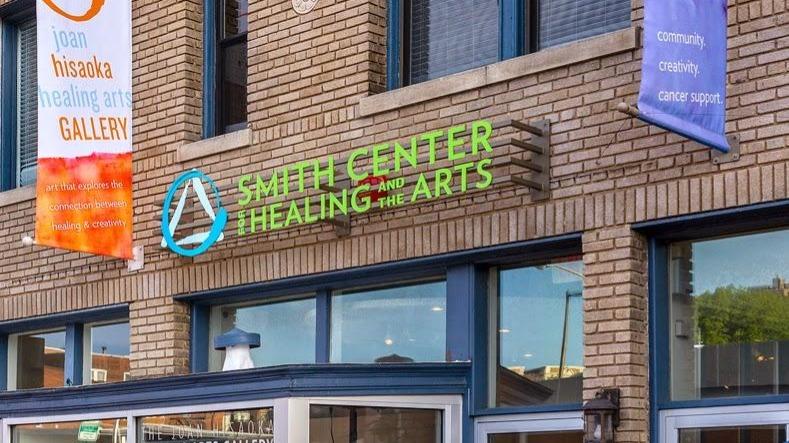
That’s where organizations like Smith Center for Healing and the Arts come in. Based in Washington, D.C., Smith Center is a nonprofit that brings together creative arts, whole person health, and cancer care. Their mission is to support adults with cancer, their caregivers and the clinicians who serve them.1 Their work is a practical example of whole person care in action, and Healing Works Foundation is proud to partner with them.
Smith Center offers support groups, educational programs, mental health support, navigation services, and arts-based programming for adults with cancer and their caregivers in person and online. There is no fee for accessing their services. For clinicians, the key element isn’t a single program but the model: structured, accessible support that addresses the lived experience of cancer outside the exam room.
Easing the burden of cancer for patients and caregivers
Much of what drives the distress you may see at your patients’ visits, and affects treatment adherence as well, happens in the spaces between visits. After diagnosis, between treatments and appointments and in survivorship, patients and their caregivers wrestle with anxiety about recurrence, grief, financial strain and spiritual questions.
ASCO’s 2023 guidelines recommend screening all patients with cancer for anxiety and depression at the initial oncology visit and regularly thereafter and providing resources to caregivers as well.2 Caregivers carry their own invisible load — sleep disruption, isolation and often, a decline in their own health and wellbeing. Targeted caregiver programs, like Smith Center offers, are important for both the caregiver and the patient.3 This may be especially true when the patient has advanced cancer, as a higher symptom burden is directly linked to caregiver burden.4
Integrative psychosocial support for patients and caregivers
Smith Center’s work spans three areas relevant to clinical care: integrative psychosocial support, creative and reflective practices and integrative oncology navigation with professional training. The Center offers support groups, workshops, and retreats for adults at different stages of the cancer journey — and for those who care for them.
Caregivers are treated as a population in their own right. Groups and workshops invite partners and family members into structured conversations about coping, boundaries, grief, and resilience — the kind of ongoing relational support most clinics wish they had time to provide.
Creative arts: Healing beyond words
Smith Center’s Joan Hisaoka Healing Arts Gallery and the artist-in-residence program show how creative expression can serve as a clinical ally. In infusion or radiation areas, an artist might invite a patient to work with simple materials during a long treatment day, or a musician might offer live music. These encounters can lower anxiety, restore a sense of control and give clinicians a calmer environment and more space for complex decision-making.
The center also offers programs designed for military veterans and their families and works specifically with Black, LGBTQIA+ and other historically underserved populations to support them through the cancer experience. There is even special programming for young adults with cancer including workshops, writing programs, hikes, and social gatherings.
Professional training for your team
Smith Center’s Integrative Oncology Navigation Training helps nurses, social workers, navigators and other allied professionals build confidence in whole person cancer care — including evidence-based complementary therapies, lifestyle support, symptom management, and care coordination. The training meets the standards set by ASCO’s recent educational update calling for clear, evidence-based guidance so clinicians can safely incorporate integrative approaches.5
How to refer your patients
If you practice in the Washington, D.C., area, connecting patients and caregivers with Smith Center is straightforward. Options include:
- Direct phone consultation. Call 202-483-8600 to discuss a specific patient or caregiver and identify the right programs or navigation services.
- Email inquiry. Reach out to programs@smithcenter.org or info@smithcenter.org for complex cases, specific groups, or upcoming retreats.
- Patient self-referral. Many workshops and support groups are open for self-enrollment. Share the website or program calendar and suggest options that fit where someone is in treatment.
- Individual integrative navigation. For people needing more intensive support, Smith Center offers individualized integrative patient navigation at no cost.
Free virtual programs are also available for those nationwide including mindfulness meditation, journaling, chair yoga and art.
A different way forward
Smith Center for Healing and the Arts shows what becomes possible when a small, community-based organization commits to creativity, connection and whole person care — and stays the course for over decades. A healing environment isn’t an abstraction. It can be built on purpose, in galleries, hospital settings or virtual conference rooms, bringing enormous benefit to patients, caregivers and clinicians.
If you’ve ever ended a visit feeling like you were sending someone home with unmet needs, you’re not alone. No clinician can meet every need by themselves. But by connecting with organizations like Smith Center, we can widen the circle of care — making it more likely that patients and families find not just treatment, but community, meaning and a pathway to healing that honors the whole person.
References
1. Smith Center for Healing and the Arts. Available at https://smithcenter.org/. Accessed April 8, 2026.
2. Andersen BL, Fann JR, Golden A, et al. Management of anxiety and depression in adult survivors of cancer: ASCO Guideline Update Q&A. JCO Oncology Practice. 2023. https://ascopubs.org/doi/10.1200/OP.23.00324
3. Northouse LL, et al. A systematic review of cancer caregiver interventions. CA: A Cancer Journal for Clinicians. 2010. https://pmc.ncbi.nlm.nih.gov/articles/PMC6594143/
4. Dionne-Odom JN, et al. Poor patient health is associated with higher caregiver burden for older adults with advanced cancer. Journal of Pain and Symptom Management. 2021. https://pmc.ncbi.nlm.nih.gov/articles/PMC8184574/
6. Mao JJ, et al. Integrative Therapies in Cancer Care: An Update on the Guidelines. ASCO Educational Book. 2024. https://ascopubs.org/doi/10.1200/EDBK_431554
Photo provided by the Smith Center for Healing and the Arts